
Independent guide · read from the terms, not the banner
Roobet Brazil: a guide that promises no link at all
Almost everyone searching for Roobet Brazil wants an address. There is none here. What there is instead is the terms, read carefully: what a deposit costs, what has to happen before a withdrawal is released, what a bonus takes away from rakeback, what the ceiling on each game is, and how to check a round on your own.
Anyone typing Roobet Brazil into a search box in English is usually after one of two things: whether the brand works for players in Brazil, and what it costs once the money is inside. This page answers the second properly, because the second is the one nobody writes down.
“Roobet Brazil” is two separate pieces of information
Two words, two questions, and they get mixed up constantly.
Roobet is a casino brand with a cashier in crypto and also in cash: the internal balance, which the terms call the Iron Pouch, has one side of each. The catalogue holds titles from large studios alongside games the house built itself — crash, mines, dice, plinko, towers, coinflip. Those last ones are the only ones where the round can be checked afterwards; how that is done is in crash.
Brazil is not a side of the brand, it is the side of whoever is searching: the questions somebody asks — signing in, is it trustworthy, bonus, withdrawal, games. That is what this site gathers under the name Roobet Brazil, without trading a single answer for a link.
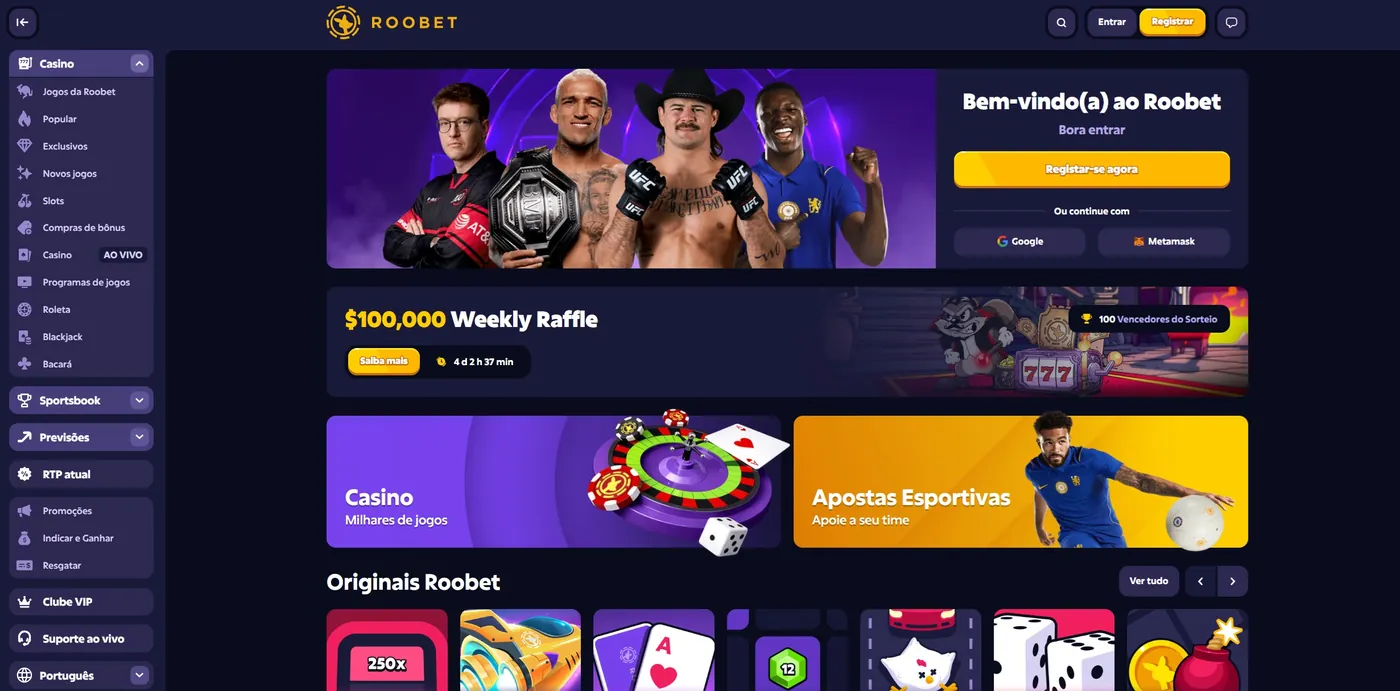
The operator's site has a Portuguese version, and the language selector sits at the foot of the side menu. That settles the navigation and settles nothing about the cashier: on the same screen, the raffle banner is still in English and the prize is still in dollars, as are the bet and win ceilings on every game. A guide that translates the interface and stops there leaves out exactly the part that costs money.
That screen also shows something almost no write-up mentions: the brand is not only a casino.

Casino and sports betting share one account and one balance, and they run on different rulebooks. The per-game ceilings, the contribution towards wagering and the round verification — everything this site calculates — belong to the casino side. The sports side has its own settlement, cancellation and grading rules. An offer that talks vaguely about “bets” has to be read knowing which of the two doors it counts, and that is the question to ask before even looking at the multiplier.
What the Portuguese searches are actually asking for
We pulled the demand in September 2026 from Google's keyword planning tool, filtered to Brazil and to Portuguese, because a guide written without looking at what people ask is a guide written for whoever wrote it. The picture is this:
| What gets typed | Searches per month |
|---|---|
| roobet | 60,500 |
| roobet brasil | 260 |
| roobet bonus | 140 |
| roobet login | 50 |
| roobet app | 40 |
| código promocional roobet | 20 |
| roobet é confiável | 20 |
| roobet crash | 10 |
| roobet mines | 10 |
| roobet plinko | 10 |
Two readings come out of that. The first: the brand on its own is searched for by a great many people in Brazil. The second, more useful one: almost nobody searches for the details. Sixty thousand people type the name, and a few dozen a month ask what a withdrawal costs or what the bonus demands.
One more thing is worth noting for anyone reading this in English: almost nobody types Roobet Brazil with a z. The Brazilian search happens in Portuguese, and that is where the 260 a month sits — so an English page on the subject is competing with a handful of pages, not with sixty thousand searches' worth of them.
That draws the whole problem. The expensive questions are the ones barely being asked — and they are exactly the ones that decide how much of your money is left.
Advertising space- Paid blockkept apart from the text
- No rankingnot a recommendation
- 18+read the terms first
What the Portuguese results hold today
After the table we took a second measurement: open what appears when somebody searches for Roobet Brasil and count what those pages carry. The result explains why this site is written the way it is.
Leaving the operator's own site aside, nearly everything that appears is a third-party address with the brand name in the domain. Four of them, measured on 24 September 2026:
| Page | Words | H2 | “official” in the code | Password field |
|---|---|---|---|---|
| A .com.br domain | 1,521 | 11 | 3 | no |
| Title with “app, APK and MOD” | 1,969 | 11 | 48 | no |
| Title with “official site in Brazil” | 2,882 | 25 | 14 | no |
| Visual copy of the lobby, in English | 3,629 | 22 | 0 | 5 fields |
Three of those four present themselves as the brand's official site in Brazil, and none belongs to the company. One repeats the word “official” 48 times in its own source. And the last carries five password fields on a page that is not the operator's — the classic shape of credential collection.
Not one of the four works out a rollover, not one says the deposit has to be wagered before a withdrawal, not one quotes a game's win ceiling. What they promise is an address, and promising an address is far cheaper than writing the page.
That is the difference here: no address, arithmetic instead.
Signing in: when the account will not open, it is usually one of six things
A password, two-factor verification on a phone that changed, forgetting which e-mail was used, a pending identity review, a pause you asked for yourself — and the sixth, signing in to the wrong site.
The sixth is the expensive one. Copying a sign-in screen costs nothing and takes five minutes; the copy is indistinguishable from the real one. The moment the password is typed there, the account has stopped being yours — and on an account holding crypto that is a move with no way back.
The pages promising an “updated link” do three things: they put their own advertising link in the middle of the path, they republish the same text every month with the date changed, or they copy the sign-in screen and keep what you type. Against the third there is only one piece of advice: type the correct address once, bookmark it, and never enter through a search result again. The rest is in signing in.
And the rule with no exception holds: a sign-in screen asks for an e-mail and a password. Any screen asking for a wallet recovery phrase, a full card number, a remote-access program or the code that just arrived by SMS is a fake.
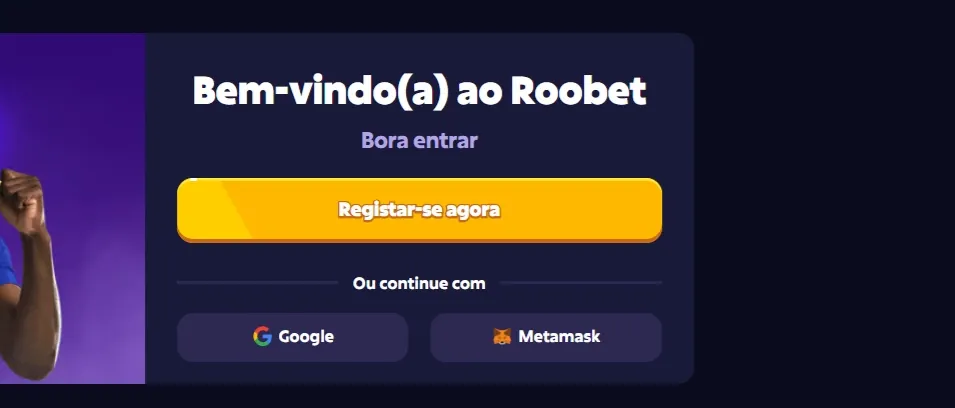
The two shortcuts beside the e-mail field each deserve a sentence. Signing in through a Google account ties access to the casino to the security of that account: whoever holds the e-mail holds the door. Signing in through a wallet swaps the password for a key — and a lost key is not recovered through a form, because there is nobody on the other side who kept a copy. In both cases the same protection is what is left: two-factor verification on, backup codes kept off the phone, and the address typed by hand exactly once.
The cashier: four numbers that are in the contract
This is the part almost every write-up about Roobet Brazil handles with adjectives. It can be handled with numbers instead, because the numbers are numbered:
1% on the way in. Clause 9.7 deducts 1% from every successful cash deposit. On R$ 100, R$ 99 arrives; on R$ 1,000, R$ 990. It does not change weight with size, but it changes weight with frequency.
The deposit has to be wagered before it leaves. Clause 10.1 says so in one sentence and 10.5(d) repeats it as a release condition. It is not a bonus locking anything: it is the ordinary deposit. Whoever treats a casino as a transit account finds this rule out on the worst possible day.
2% from the tenth withdrawal. Clause 10.8 charges 2% per cash withdrawal once you reach ten or more in a rolling thirty-day period, counting the tenth. Withdrawing in slices costs money; withdrawing in one go does not.
The balance has two sides that do not convert. The Iron Pouch (clause 3.4) has a cash side and a crypto side, and clause 4.5 of the bonus policy says value coming from a bonus, a promotion or an offer does not cross from one to the other. All rakeback, under clause 5.6, lands on the crypto side.
The table with the weight of 1% at four different amounts, and what happens when a withdrawal request is refused, are in deposit and withdrawal.
From Pix to balance: the path, and the step that does not come back
Whoever deposits in reais comes in through the cash side of the balance, and the 1% of clause 9.7 lands there. Whoever deposits in crypto passes through four stages, and only the last one happens inside the casino:
One. An account at an exchange. The checks on that side are detailed and are done once.
Two. Getting the reais into the exchange. A transfer usually comes out cheaper than a card, and the difference shows up on the first deposit already.
Three. Choosing which coin the balance sits in. A stablecoin keeps the value still; a volatile coin turns your balance into a currency position with a casino on top of it. A balance in a volatile coin loses value without you playing a single round.
Four. Sending to the casino's deposit address, on the network it specifies. This is the only step that does not come back.
The most common mistake in step four is the network. The same stablecoin exists on several networks; the deposit page credits only some of them, and the list changes over time. An address is pasted, a network is read off the screen, and with a new destination you send a small test amount first.
The second cost on that path is the network fee: a fixed amount that does not grow with the size of the transfer. Twenty reais of fee is irrelevant on a R$ 2,000 send and is 10% on a R$ 200 send. The practical consequence is to deposit fewer times and in larger amounts — with the amount decided before the cashier is opened, not during.
And the contract has a line that closes the subject: under clause 10.11, a wrong or invalid address is your responsibility, and the company does not answer for the value.
If a withdrawal was refused, look in this order
It is almost always one of these five, and in this order:
- An active bonus. While wagering is outstanding, the whole balance is
usually locked, not only the bonus part.
- The requirement to wager the deposit (clause 10.1) has not been met.
- Verification pending. Clause 10.5(a) requires a verified identity.
- Payment method. Clause 10.7 asks for the same method used for the
deposit; 9.2 and 8.14 forbid a third party's method.
- Several requests open at once. Clause 10.3 allows all of them to be
refused and one request for the total to be asked for instead.
None of those five is solved by repeating the request. Four of them are solved before the money exists, which is why they are worth reading today rather than on the day of a win.
Verification always turns up at the worst moment
Clause 4.9 allows documents to be asked for at any time and deposits and withdrawals to be restricted until the review is finished. Since almost nobody sends anything before winning, the review lands precisely on the first withdrawal — hence the reputation for a slow first payout.
The KYC policy describes what is checked: identity, sanctions and politically-exposed-persons lists, and source of funds where relevant. There is also continuous monitoring of transactions and of play patterns, and reporting to the Curaçao financial intelligence unit.
The only legitimate shortcut is to send the documents on a day when you are not waiting for money. What usually gets rejected — a cropped photo, an old statement, a name different from the registration — is listed in verification.
One rule in that chapter deserves highlighting because it catches people acting in good faith: clause 4.12 obliges you to tell support about any account belonging to a close relative who shares a device, a home or a network with you. Not telling them is treated as a deliberate attempt to get around the rule, and it leads to the accounts being closed.
Bonus and rakeback: taking one switches off the other
Here is the least-quoted finding in the whole rulebook, and it changes a decision:
Clause 5.5 — while there is wagering outstanding from a deposit bonus, no form of rakeback is paid.
Rakeback is continuous; a bonus happens once. So accepting the offer is not getting something for free, it is trading a flow for an amount — and the trade only pays if the wagering is cleared fast enough. The calculation that decides it is: how long do I take to clear the wagering, and how much rakeback would I have accumulated in that time.
The four rakebacks, under clause 5.1, are instant, daily, weekly and monthly. Three details that cost money if you do not know them:
- The instant one can be claimed every thirty minutes and does not expire; it
sends 50% to the balance and 50% to the vault, released over three days (clause 5.18).
- Daily, weekly and monthly reset to zero if they are not claimed before the
next period — and the periods turn at 00:00 UTC, which in Brasília is 9 p.m. the previous day. Leaving it to the end of the night loses the whole period.
- The level goes up to 30 (clause 5.4) and raises the value of three of the four
rakebacks; the instant one is excluded (clause 5.3).

The VIP club page describes those same rewards in another register: cashback on activity, weekly rewards for playing slots, monthly promotions. Nothing there is false, and nothing there mentions clause 5.5. It is not a contradiction, it is a division of labour: the promotion page sells, the terms attach the condition, and when the two disagree the terms hold — they are what the company signed. Whenever a benefit turns up on a colourful page, the next step is to look for the number of the clause that covers it.
The rest of the offers — Rain with a requirement of US$ 250 wagered in 48 hours, RooSpins expiring in seven days, bonus buys on the same deadline, referrals worth up to 10% of theoretical margin — is set out in bonus and rakeback.
How to read any offer in one minute
Five numbers, always the same ones:
- The multiplier.
- What it applies to: the bonus alone, or bonus plus deposit.
- Each game's contribution.
- The maximum bet allowed while wagering is active.
- The deadline.
With numbers: R$ 200 of bonus at 35x is R$ 7,000 wagered. If the rule counts bonus plus deposit and you deposited R$ 200, that becomes R$ 14,000. If the game you chose contributes 10%, it becomes R$ 140,000. The multiplier did not change at any point — what changed is what was written beside it.
If one of the five is missing, the offer was not written to the end, and the missing part is never the one in your favour.
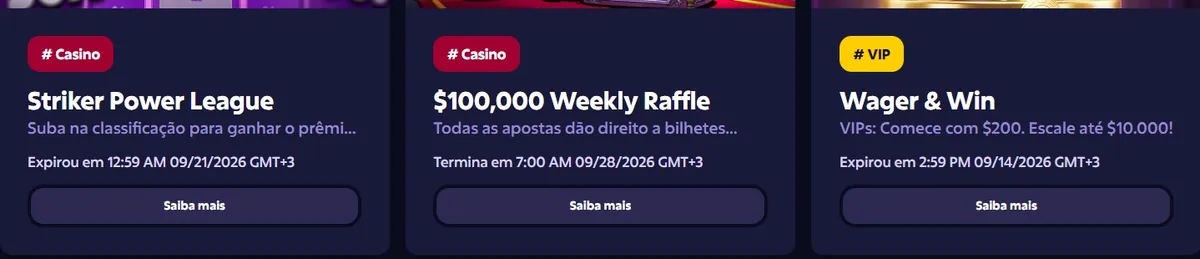
There is a sixth number missing from that list, and it is not about the offer but about the clock. Every promotion carries a deadline line, and that line carries a time zone written beside the hour. That zone is hardly ever Brasília's, and the difference shows up in full on the last day: a deadline ending at seven in the morning in a zone six hours ahead was already over at one in the morning here.
The same care applies inside the terms, and there the number is known: the rakeback periods turn at 00:00 UTC, which in Brasília is 9 p.m. the previous day. That is two different clocks on one site — one for the rakeback periods, another for the promotion deadlines. Before counting how many hours are left, read which of the two is written on the screen.
Games: two halves under different contracts
The house's half. Crash, Dice, Mines, Jungle Mines, Towers, Plinko, Roulette and Coinflip. Fixed, written ceilings: a maximum bet of US$ 20,000 (Plinko US$ 10,000, Coinflip US$ 200,000) and a maximum win of US$ 500,000 (Coinflip US$ 384,000), with the sentence that saves an argument — wins above a game's limit do not happen. These are also the titles where the round can be verified.
The studios' half. Here the limits change by title: a maximum bet of US$ 3 to US$ 20,000 and a maximum win of US$ 5,000 to US$ 15 million, always in the game's own information box. The number that matters is in no review — it is inside the version you opened, and the casino chooses which version goes into the lobby.
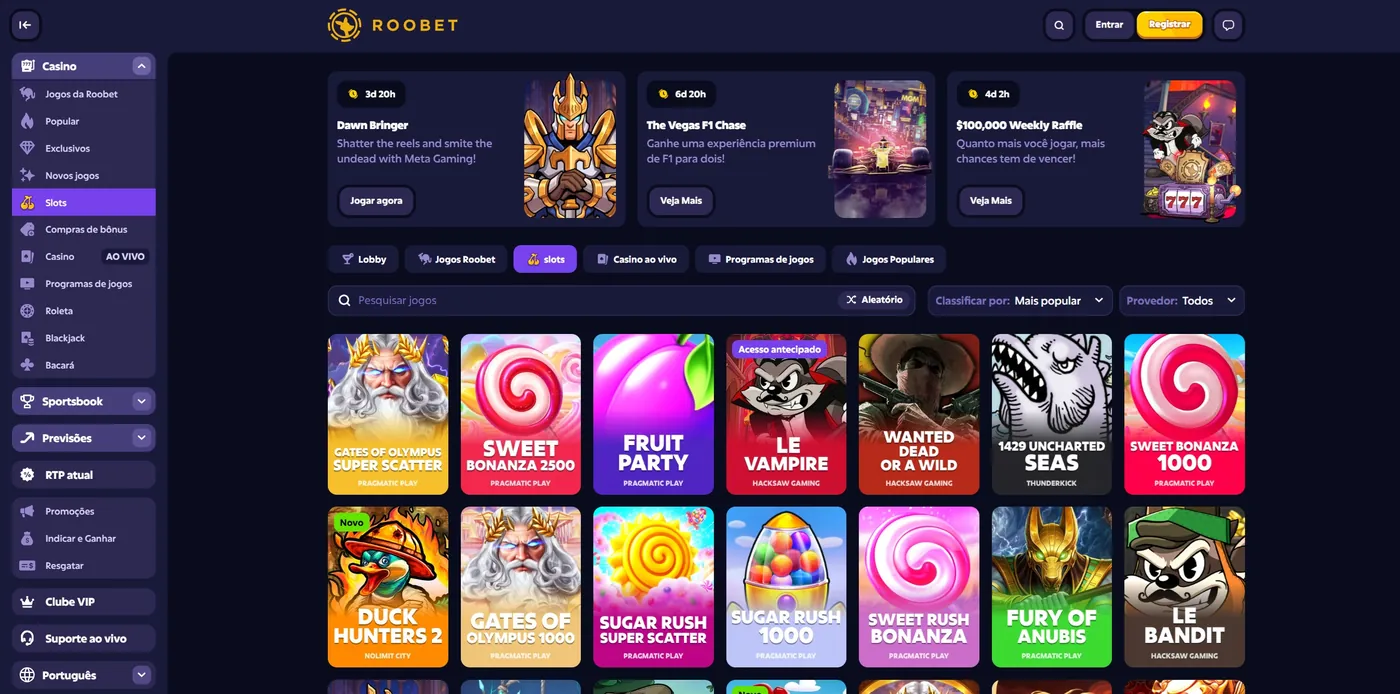
The path to that number is always the same, and it has three steps: filter the catalogue by provider, open the title, and read the information box of the game you opened. Bet ceiling, win ceiling and theoretical RTP live in there, in the version the casino put in the lobby — not in the shop window and not in any review. And the shop-window order does not enter that calculation: “most popular” counts how many people opened the game, not what it pays.
Two details show up only in the rulebook: in Mines, choosing more than 24 mines makes you lose automatically if you do not cash out before risking a guess; and on Roulette, 0.666% of every bet goes to the progressive jackpot. The full list is in games and limits.
Crash, the rocket game
The graph rises and breaks at a random moment; cash out before that and the bet is multiplied by the number on screen. Two sentences from the rulebook are worth more than any published strategy: the lowest possible result is 1.00, and the chance of busting increases as the graph rises (clause 4.15).
The second sentence is the whole game. There is no safe height; there is the trade between a larger multiplier and a smaller probability, designed so the average stays with the house. Auto cash-out improves no chance at all — it solves the human reflex and the dropped connection, and clause 4.67 warns that auto-betting keeps running if you fall off the network.
The three ideas that circulate — “after several low ones a high one comes”, “there is a time of day that pays more”, “this bot predicts the bust” — all die on the same sentence: the round's fingerprint exists before any bet is placed on it. Details in crash.
Mines: the only choice that matters
You pick between 1 and 25 mines, open squares and cash out whenever you like. The multiplier per hit grows with the number of mines, and the chance of stringing hits together shrinks in the same proportion. It is the crash trade with a different drawing.
The grid has no memory: the mine positions come from the round, and the round has a fingerprint published before your first choice. Maps of “hot” squares describe what has already happened. The whole mechanic is in mines.
Verifying a round: two minutes, and almost nobody does it
- Before the round, the house publishes the fingerprint (hash) of the result.
- Afterwards, it reveals the number that produced that fingerprint.
- You recompute the fingerprint from the revealed number and compare.
If they match, the result was not chosen after your bet. It is a narrow check, and it is honest to say how far it goes: it proves that round was not swapped, it does not prove the game's mathematics is good for you, and it says nothing about a withdrawal being paid.
Live RTP: an honest number used the wrong way
The house publishes each game's real return in windows of 10 minutes, 1 hour and 24 hours, with the formula in plain sight: total paid divided by total wagered, times a hundred. Publishing that is rare and it is good.
The problem is the sample size. On a slot, most of the return comes from a few large hits spread across thousands of spins; in ten minutes, the number mostly measures who got lucky just now. A “hot” game is a description of the past, and the next round does not consult the previous one. The 24-hour window is the only one of the three worth looking at, and for one thing only: comparing it with the title's theoretical RTP. The full reasoning is in live RTP.
Volatility: the second number, which explains the evening
Two games with the same RTP can behave in opposite ways. What separates them is volatility: how many large and small pieces that average return is divided into.
Low volatility delivers small, frequent wins; the balance melts slowly and the session lasts. High volatility delivers nothing for hundreds of spins and settles everything in one — the same return is there, distributed far more rarely.
The consequence is a budgeting sentence: in a high-volatility game, the number of rounds needed for the average to show up is a multiple of the number in a low-volatility one. With R$ 100 and R$ 2 bets, that is fifty rounds — not a number in which you can expect a result that lands once in five thousand. The same R$ 100 at R$ 0.20 a round gives five hundred. The game did not change; the measuring time did.
Twenty minutes, counted properly
A short session looks cheap. The arithmetic disagrees. With R$ 1 bets and a round every six seconds, twenty minutes is two hundred rounds and R$ 200 wagered. At a theoretical return of 96%, the expected loss on that volume is R$ 8 — and the variation around it is far larger than eight reais in either direction.
The number that matters is not the bet, it is the volume per hour. That is what turns “just a little” into an amount. And it is why a deposit limit is worth more than any choice of game.
The first week of a new account
What usually goes wrong with Roobet Brazil does not happen on day one, it happens on day seven. An order that avoids most of it:
- Day 1. Two-factor verification on, backup codes on paper, deposit limit
set, documents sent.
- Days 2 to 5. One small deposit. No bonus. Play part of it, withdraw the
rest. That single exercise answers in practice what the rulebook only promises.
- Day 6. Only now weigh up an offer, knowing it switches rakeback off while
wagering is outstanding.
- Day 7. Look at the whole week's statement: deposited, wagered, withdrawn.
Those three numbers together say more than the feeling of how the week went.
Ten short answers about Roobet Brazil
- Is there a link here? No, and there will not be.
- What does depositing cost? 1% in cash, clause 9.7.
- Can you withdraw without wagering? No, clause 10.1.
- Is there a withdrawal fee? From the tenth in thirty days, 2%, clause 10.8.
- Does a bonus lock the whole balance? Usually yes, not only the bonus part.
- Does a bonus switch rakeback off? Yes, clause 5.5.
- What is the win ceiling on the house games? US$ 500,000.
- Can a round be verified? On the house games, yes.
- Do you need an app? No; the browser does the same work.
- How long does a withdrawal take? We do not know — which is why it is not
written here.
Why there is no ranking and no score here
A ranking would be odd here to begin with: Roobet Brazil is one subject, not a market, and a list of one is not a list. The deeper reason is that a ranking funded by advertising is a price list with stars drawn on it. With no list there is no position to sell; what is left to sell is space, and space is visible — it is the block marked Advertisement, kept apart from the text and carrying no brand name in the middle of the pages.
In place of a score there are repeatable things: the rollover multiplication, the weight of 1% at four amounts, each game's ceiling, what a ten-minute window really measures. None of them asks you to believe us. The full reasons are in who writes this.
Five common misreadings
Five sentences that circulate about Roobet Brazil, and what the documents say instead:
| The misreading | What is written |
|---|---|
| “Crypto is instant, so the withdrawal is immediate” | Internal approval is a separate step from the network |
| “A bonus is extra money” | It is balance with a condition; and it switches rakeback off |
| “High RTP now means bigger payouts now” | A short window measures who got lucky, not the game |
| “The official site is the one with the brand in the domain” | Three of the four measured say that and none belongs to the company |
| “An app is safer than the browser” | A third-party installer is a file from an unknown source |
Writing to support: four things that work
One question per message. Three questions come back with one answer.
Quote the clause. “10.5 requires a verified identity; mine has been verified since the 3rd” changes the tone of the conversation.
The whole screenshot. The crop that hides a date or an amount is what makes the agent ask for everything again.
Never share anything that grants access. A password, a verification code and a recovery phrase are asked for by no support desk anywhere.
On a phone: three adjustments
Add the page to the home screen instead of installing any file. It runs full screen, with no permissions and no unknown source.
Leave notifications off. It is the one function the browser does not do, and it is the commercial reason casino apps exist.
Turn the session reminder on. A small screen hides the clock better than a large one.
A short glossary
Six words that keep coming back on any Roobet Brazil page, including this one:
Iron Pouch — the name the terms give the internal balance; it has a cash side and a crypto side, and they do not convert.
Rollover — how many times an amount has to be wagered before it can leave.
Rakeback — a return of part of what was wagered, continuous and in four tempos here.
Vault — where part of the rakeback is held, released over several days.
Provably fair — the check that shows a round was not swapped after the bet.
Volatility — the size of the pieces a game's return is delivered in.
Five things this site does not claim
- That any casino pays out in X minutes.
- That any offer is the best on the market.
- That a strategy exists which turns a game's mathematics around.
- That this site has any connection to the brand it names.
- That gambling is a way to make money.
Where to go from here
Every question on this site is one of five, and Roobet Brazil in the search box is usually the first of them.
If the question is the account, start with signing in. If it is money, with deposit and withdrawal. If it is the offer, with bonus and rakeback. If it is trust, with is Roobet trustworthy. And if the question is whether it is time to stop, safer play is the most important page of the lot — with contact open for any number that needs correcting.